


Clinical documentation has quietly become one of the most powerful, and misunderstood, drivers of healthcare performance.
It shapes care continuity.
It determines reimbursement accuracy.
It protects against audit exposure.
It influences risk adjustment scores.
And yet, in 2026, documentation still feels like friction.
Physicians are charting after hours. Coding teams are digging through dense narratives. Revenue cycle leaders are managing denials tied to vague medical necessity statements. Payers are reviewing inconsistent clinical language.
Healthcare has invested heavily in artificial intelligence. But here’s the reality:
Most AI tools were built for language.
Healthcare needs systems built for medical reasoning.
That distinction is why precision-built clinical NLP is emerging as a strategic differentiator, not just another automation layer.
Revenue Integrity Begins with Documentation Precision
In today’s regulatory environment, documentation precision directly impacts financial performance.
Guidelines from the Centers for Medicare & Medicaid Services require explicit medical necessity justification and precise diagnosis capture under ICD-10-CM. Procedure reporting must align with Current Procedural Terminology, and chronic conditions must be documented accurately for Hierarchical Condition Categories scoring.
When documentation lacks structure, downstream automation suffers.
For example, organizations that deploy AI Automated Claims Management systems often discover that claims automation performs best when documentation is already structured and specificity-driven. Clean documentation produces clean claims. Poor documentation simply accelerates denials.
Clinical NLP strengthens that foundation before claims ever reach submission.
Compliance and Audit Readiness Require Structural Clarity
Increased audit scrutiny has made compliance oversight more proactive than reactive.
When documentation is inconsistent, compliance teams spend time defending instead of optimizing. Structured documentation powered by clinical NLP reduces ambiguity and strengthens defensibility.
This becomes even more impactful when paired with broader AI Agents for Healthcare Compliance Oversight, which continuously monitor documentation patterns and flag risk before it escalates into external audit exposure.
The combination transforms documentation from a liability into a protective asset.
Upstream Intelligence Shapes Downstream Accuracy
Documentation quality does not begin at the physician note. It starts at patient intake.
Incomplete histories and fragmented intake narratives create complexity that cascades through the clinical record. Organizations modernizing front-end workflows with AI-Powered Patient Intake in Healthcare Operations often see downstream improvements in documentation clarity and NLP accuracy.
When intake data is structured and consistent, clinical NLP can interpret physician documentation more effectively, improving both coding precision and revenue outcomes.
Documentation intelligence is strongest when the entire care journey is aligned.
Security Is Not Optional, It Is Foundational
Any discussion of clinical NLP must address data privacy.
These systems process protected health information, which means security frameworks must be non-negotiable. Organizations implementing documentation automation must ensure alignment with HIPAA Compliance for AI in Healthcare standards, including encryption, access controls, audit logging, and governance transparency.
Precision in interpretation must be matched by precision in protection.
Without trust, AI adoption stalls.
With strong safeguards, transformation accelerates.
Strategic Comparison: Generic AI vs Clinical NLP
To clarify the distinction, consider the following:
| Dimension | General Documentation (Generic AI) | Clinical NLP Documentation |
| Core Capability | Summarizes, rewrites, and organizes general text | Interprets clinical intent, extracts medical meaning, and structures data |
| Primary Focus | Language clarity and readability | Clinical accuracy and medical context interpretation |
| Coding Awareness | Minimal or none | ICD-10, CPT, HCC, DRG aligned |
| Revenue Impact | Indirect support (improves documentation quality) | Directly improves reimbursement accuracy and denial prevention |
| Compliance Support | Limited regulatory understanding | CMS, payer, and audit-aligned outputs |
| Clinical Reasoning Recognition | Cannot interpret provider intent or diagnostic relationships | Understands medical necessity, risk adjustment, and hierarchical conditions |
| Medical Terminology Handling | General understanding of common health terms | Specialty-trained models with deep clinical vocabulary |
| Risk Adjustment Support | Not optimized for RAF scoring | Supports HCC capture and risk score optimization |
| Denial Prevention Capability | No direct linkage to payer logic | Identifies documentation gaps that lead to denials |
| Audit Readiness | Produces readable notes | Produces audit-traceable, compliant, and defensible documentation |
| Structured Data Extraction | Basic keyword extraction | Converts unstructured notes into structured EHR-ready data |
| Use Case in Healthcare | Drafting patient letters, summaries, general notes | Coding validation, CDI support, utilization review, prior authorization |
| Regulatory Alignment | Broad and non-specific | HIPAA-aware, payer-guideline aligned |
| Healthcare Specialization | Broad language model | Clinically trained on specialty-specific datasets |
This difference determines whether AI becomes a surface-level productivity tool or a structural revenue integrity engine.
From Notes to Actionable Insights with Clinical NLP
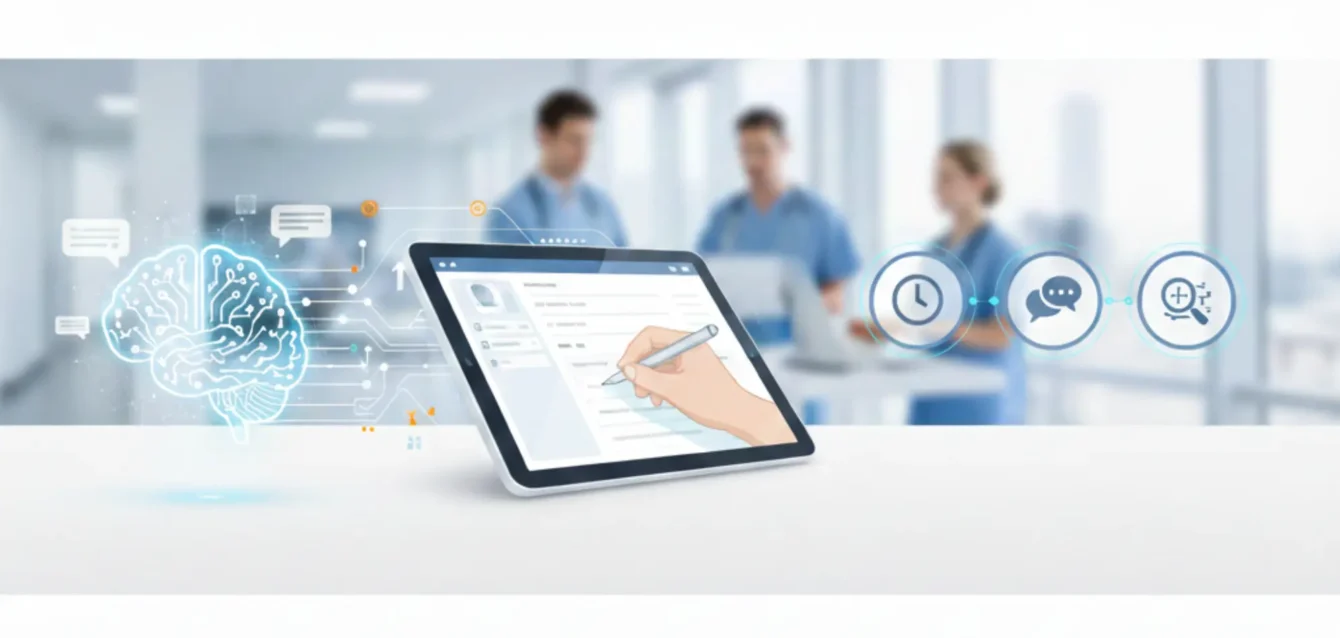
Turn every clinical note into actionable insights with NLP, helping your team work smarter, document accurately, and make confident healthcare decisions.
Conclusion: From Documentation Burden to Documentation Intelligence
In 2026, healthcare organizations don’t need more disconnected automation tools. They need structured intelligence that transforms clinical narratives into operational clarity.
At CaliberFocus, our NLP capabilities are purpose-built to streamline clinical documentation with precision, compliance alignment, and enterprise scalability.
We support clinical documentation transformation through:
- Advanced Text Analytics & Clinical Language Interpretation
Interpreting medical narratives, identifying diagnostic intent, extracting themes, and detecting clinically significant trends across documentation types. - Named Entity Recognition (NER) & Clinical Information Extraction
Converting unstructured physician notes into structured data by identifying diagnoses, procedures, severity indicators, medications, lab findings, and chronic condition restatements aligned with coding and risk adjustment standards. - Medical Voice Recognition & Speech-to-Text Integration
Transcribing dictated clinical notes with domain-tuned medical vocabulary and structuring them for coding, compliance, and revenue workflows. - Intelligent Document Understanding & Classification
Processing discharge summaries, operative reports, pathology notes, and compliance documents to automate data extraction, reduce manual review effort, and improve audit readiness.
This is not generic automation.
It is clinically aligned, compliance-aware NLP infrastructure built for healthcare environments where accuracy, security, and scalability are non-negotiable.
At CaliberFocus, we bring deep experience in clinical documentation streamlining, helping providers, payers, and healthcare enterprises transform documentation from administrative overhead into a strategic intelligence asset.
Because in 2026, documentation should do more than record care.
It should strengthen the entire healthcare ecosystem.
Frequently Asked Questions
One of the biggest concerns is workflow disruption. Properly implemented clinical NLP systems operate in the background. Physicians continue documenting naturally, whether typing or dictating, while the system interprets and structures the information. The goal is augmentation, not workflow replacement. When integrated correctly with the EHR, adoption feels incremental rather than invasive.
Clinical NLP is not designed to replace human expertise but to enhance it. High-quality systems trained on medical datasets can achieve strong entity extraction and interpretation accuracy, especially for diagnosis and procedure identification. Human oversight remains essential for validation, but NLP significantly reduces manual abstraction time while improving consistency.
This is a common concern. In reality, structured documentation often reduces audit risk because it improves clarity and defensibility. The key is choosing compliance-aligned NLP systems that operate with medical guardrails and transparent logic. Organizations should maintain human review workflows during early adoption to build confidence.
Yes, when denial causes are documentation-related. Many denials stem from insufficient specificity or weak medical necessity linkage. NLP strengthens these elements before claims submission. However, NLP is not a cure-all; payer policy complexity and eligibility issues still require broader revenue cycle optimization.
Most enterprise NLP solutions integrate through APIs, FHIR standards, or secure backend connectors. Integration typically focuses on reading documentation, structuring insights, and pushing summarized outputs back into coding or compliance workflows. Successful implementations prioritize minimal disruption to clinician-facing interfaces.